



Shefaly Yogendra is likely one of the smartest folks I do know. I’ve stated this to her earlier than and I stated it once more on the day her e book got here out. She is whip-smart. She sees patterns earlier than most individuals’s brains have even registered what’s in entrance of them. I’ve watched Shefaly apply it throughout extra industries and contexts than most individuals encounter in a lifetime.
Episode 171 of The Naina Expertise was recorded on the morning of her e book launch. Her e book, Uncharted Areas, was launching that night at The Shard. It’s her first e book, and as she identified, the phrase “first” already carries an assumption {that a} second is coming.
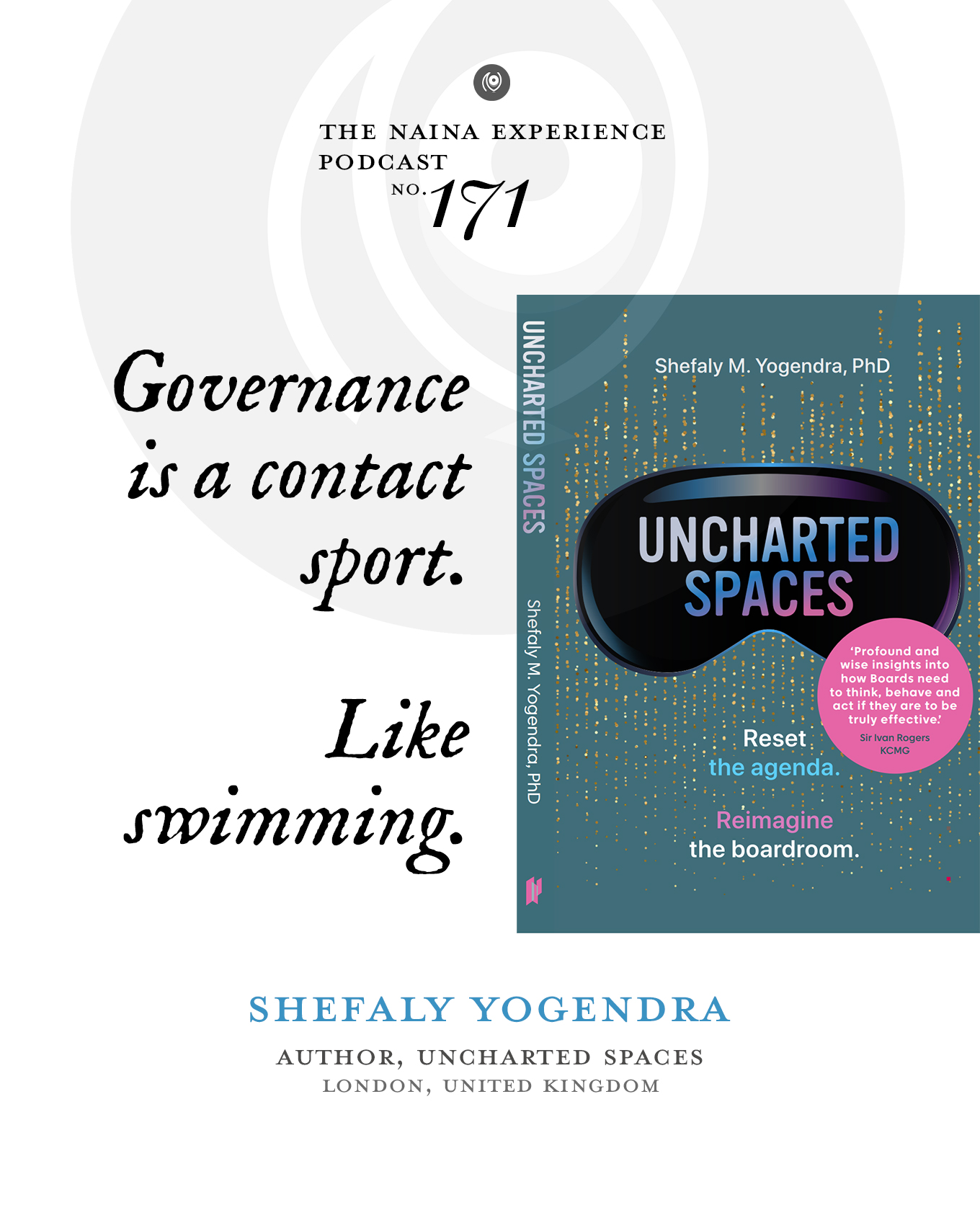
The duvet of Uncharted Areas has a pair of digital actuality glasses on it. Once I requested why, she informed me a couple of query a neighborhood of board administrators had requested her the day earlier than: how do you see the start of the start of one thing? Her reply is that you simply begin to see once you have interaction with the world and observe with out feeling the stress to react. Most individuals take heed to reply. Only a few folks pay attention to take a seat with one thing and make sense of it. The glasses are there to say one phrase. Look.
She launched me to the phrase metacognition years in the past, and I’ve related it together with her ever since. Within the episode she defined it plainly. What we do is what we get engrossed in. The educational and the transferability come once we summary one layer up. The abilities you utilize to unravel an engineering drawback are the identical abilities you utilize all over the place else in life. The perfect use of formal training, she says, is to use its ideas to your personal life. Individuals have a tendency to order summary ideas for work. They miss the purpose.
She introduced this again to community industries. Individuals consider the web as a community, or cell phone networks, or water. They don’t consider roads as networks. However worth is created each time one thing strikes from one node to a different, whether or not that one thing is a truck, an electron, water, or an thought. She and I have been two nodes on a name between Australia and the UK, and the purpose of the dialog was to create one thing one other particular person might use.
We talked about boards and what they really do. The manager workforce runs the corporate everyday. The board helps form and agree the technique, makes positive the cash and the persons are there to execute it, and retains a watch on whether or not the organisation is retaining its regulatory and social licenses to function. Shefaly is obvious that companies function as a result of they’ve a social license, and when that license is violated, there are penalties. She offers the instance of a big multinational beverage firm accused of contaminating water in arid nations. In Australia, the place water is valuable, the instance lands laborious.
She additionally tackled boards throughout jurisdictions. The UK runs on a principle-based governance system. The US runs on a rule-based one. Ideas enable judgment. Guidelines offer you compliance or breach, nothing in between. A variety of Commonwealth nations run a model of the UK system. There may be additionally an OHADA system that governs 17 Francophone nations in Africa, and Shefaly has quoted somebody within the e book who sits on boards below each OHADA and Anglo-Saxon programs. The mechanics of the conferences differ. She is cautious to say that once you enter a brand new governance context, you spend your first 100 days listening. Two eyes, two ears, two fingers, one nostril. Observe, ask questions, then begin to supply.
The phrase “belief in God, however lock your automotive” got here up. I first heard it as a teen and thought it was cool with out figuring out what to do with it. Shefaly’s studying is about verification. Begin from belief. Then ask for proof. When you find yourself signing annual accounts or a compliance report, you don’t start by distrusting the method. You ask the method to point out you it labored.
We spent a great chunk of the hour on why she wrote this e book. A buddy in a male-dominated trade known as her in 2024 and requested, in case you have been beginning out on boards at the moment, how would you start? Shefaly couldn’t reply her. Her personal begin got here via a Board Apprentice Program that has not scaled as a result of host boards don’t at all times present up for it. That query stayed together with her. On high of that, she has had an unusually eventful ten years on boards. An IPO. An acquisition. A merger between two FTSE 250 firms that created a FTSE 100 firm. A fund supervisor change performed totally on Zoom throughout the first COVID lockdown, when most individuals have been nonetheless figuring out tips on how to unmute themselves. Lots of people-related crises. A variety of hiring and intervention and conversations about management that she had finished extra of in ten years than in all of the years earlier than.
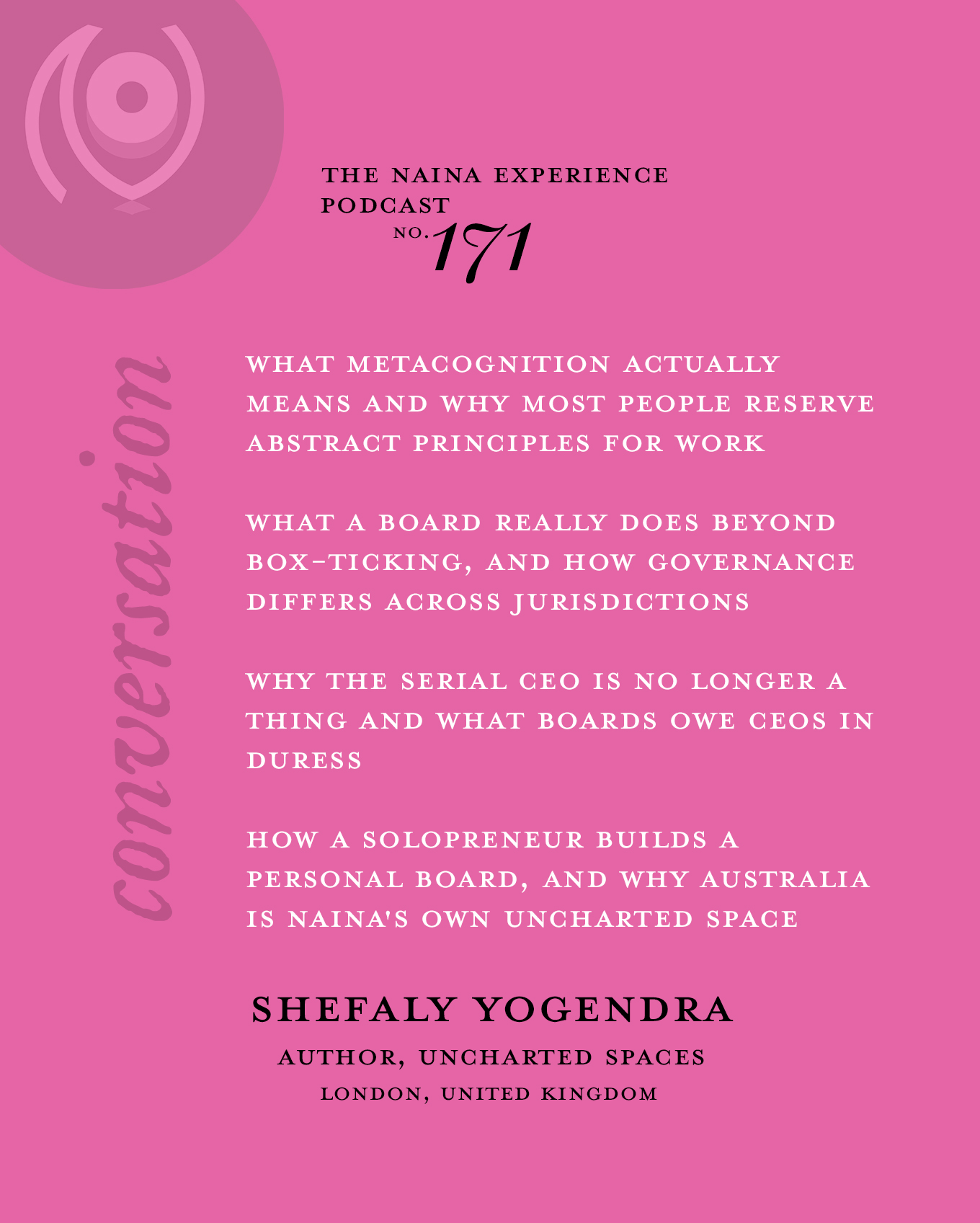
She additionally stated one thing about CEOs that stayed with me. The stress on CEOs now’s actual and sustained. The serial CEO is now not a factor. Individuals don’t need to do the job twice. If a CEO is having a breakdown, the board has each a human obligation and a authorized one to stage an intervention, as a result of a CEO can commit the corporate to selections whereas their judgment is below duress. Only a few folks need to speak about this. Shefaly does.
The a part of the dialog that mattered most to me personally was about constructing a board for your self when you’re a solopreneur. I do not need a board. It has been twenty-two years of working as an impartial contractor and a freelancer. Shefaly’s recommendation is {that a} private board is an actual factor. A small group of individuals you belief, who perceive you, who you go to not for each day contact however for sense-making, problem, and assist. Completely different folks for various issues. Some are good in peacetime, some in wartime. Don’t ship the peacetime ones to cope with a warfare. Know which is which.
She reframed Australia as my very own uncharted area. I had not considered it that means earlier than. I had been framing it as survival mode. She known as it a continent, a brand new tradition, a chance, and identified that I used to be already seeding issues with Adelaide Collective and the neighborhood I’m constructing in particular person. The e book, she stated, is for me as a lot as it’s for individuals who sit on boards.
We additionally talked concerning the epistemic disaster. The erosion of the actual fact base. Individuals scrolling via a lot info that nothing sticks, as a result of there’s nothing to stay it to. Conversations are tougher as a result of persons are not bringing details or tales, solely opinions rooted in choice. Shefaly is blunt about this. It degrades public discourse. When public discourse degrades, democracies do too.
The e book launched that night at The Shard, within the workplaces of Amper, hosted by its CEO Sarah. Fiona, who wrote the foreword, was there. Shefaly’s first chairman from her board apprentice days was there. A neighborhood of girls administrators turned up. A photographer was taking photos so I might see them from Adelaide.
Uncharted Areas is obtainable now. I will likely be highlighting my means via it.
Visitor Hyperlinks:
E-book Instagram: https://www.instagram.com/unchartedspaces
E-book Web site: https://unchartedspaces.information/
Purchase on Amazon: https://www.amazon.com/Uncharted-Areas-agenda-Reimagine-boardroom/dp/1788608763
Naina’s Hyperlinks:
E-book the podcast: https://www.naina.co/product/the-100-podcast/
Instagram: https://www.instagram.com/naina
Web site: https://www.naina.co
Spotify: https://open.spotify.com/present/5HwVipVYnxARyEjp4onfvp
YouTube: https://www.youtube.com/@nainaredhu
Watch the complete episode on YouTube & Spotify
Associated
