



Why Alexander Calder Tapestries Really feel So Up to date in Right now’s Interiors
Tapestry is having a placing return to relevance. As soon as related primarily with historic castles and formal interiors, woven artwork has been reclaimed by a brand new era of collectors and designers who see it as one of the crucial versatile methods to convey colour, texture and scale right into a room — as a lot nice artwork as design component. On the heart of that shift is a physique of labor that will shock even art-savvy readers: the tapestries of Alexander Calder. Greatest identified for inventing the cell — these delicately balanced sculptures that appear to hold and switch in mid-air — Calder was one of many defining figures of twentieth-century artwork, and his daring, immediately recognizable vocabulary has translated with exceptional ease into woven kind. Right now, Alexander Calder tapestries sit on the intersection of nice artwork, collectible design and inside styling, providing a method to dwell with trendy artwork at a scale no portray or print can match.
A Vocabulary Constructed for the Wall
Calder’s genius was by no means actually a few single medium. Educated as an engineer earlier than he turned an artist, he approached kind the way in which a physicist approaches movement: as stability, pressure and counterweight rendered seen. His signature parts — biomorphic blobs, sharp triangular fins, circles that learn as suns or planets, a palette anchored in major purple, yellow and blue towards black and white — turned one of many defining vocabularies of twentieth-century artwork. The place the Surrealists gave him his natural shapes and Mondrian his colour self-discipline, Calder gave the century one thing fully his personal: composition that felt mild, playful and in fixed, quiet movement, even standing nonetheless.
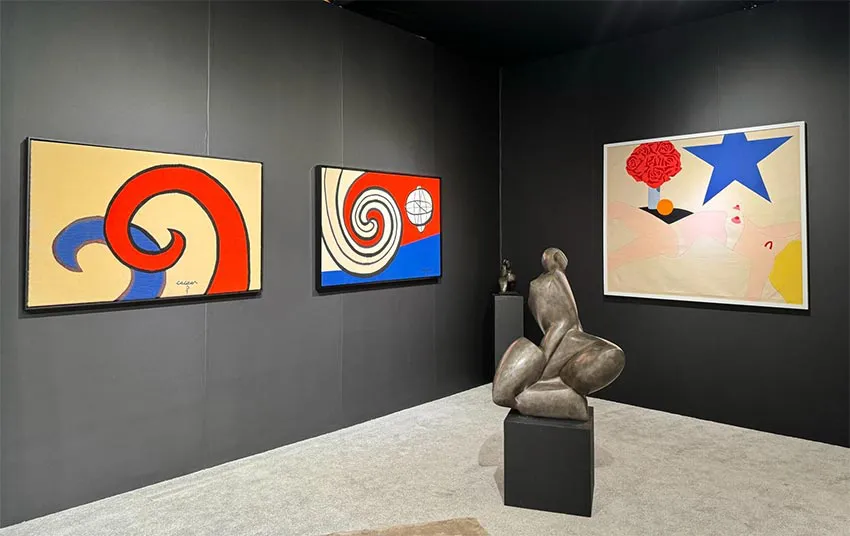
That sense of motion is exactly what makes his work so receptive to translation. A Calder gouache or ink drawing is already pondering in flat planes of colour and daring, economical line, which is, in essence, the identical language a tapestry cartoon requires. When Calder’s compositions have been tailored into woven kind, largely by the historic ateliers of Aubusson in France starting within the Sixties and 70s, the leap from paper to loom felt much less like a translation and extra like a homecoming.
What Weaving Provides That Paper Can not
A print or a piece on paper is, by nature, flat and quick. A tapestry is neither. Wool has depth; it catches mild otherwise throughout a single discipline of colour, so {that a} purple aircraft is rarely fairly one purple — it shifts subtly as you cross the room, the way in which Calder’s mobiles shifted with the air currents of a gallery. The weft and warp introduce a visual, tactile grain, a texture that provides even his most graphic, hard-edged shapes a heat and a bodily presence no print can replicate. After which there may be scale: many Calder tapestries have been woven at a dimension that might be impractical, even unthinkable, on paper, a number of meters throughout, meant to be lived with slightly than merely considered from throughout a room. Woven artwork of this sort occupies a room in a method that works on paper by no means fairly can.

A Pure Match for Trendy Rooms
That is exactly why Alexander Calder tapestries sit so comfortably in modern, minimalist and trendy architectural interiors. A room stripped of decoration — concrete, glass, pale oak, unfussy furnishings — wants one factor to maintain it from feeling austere: a focus with sufficient colour and vitality to hold the entire house, however with a proper self-discipline that doesn’t combat the structure. Calder’s compositions do each directly. They’re daring with out being chaotic, playful with out being ornamental within the fussy, conventional sense. In a minimalist lounge or a thought of gallery-style hallway, a large-scale Calder tapestry can operate virtually architecturally, establishing rhythm, anchoring a sightline, giving a impartial palette its one needed jolt of colour, a lot the way in which a chunk of furnishings or a change in ceiling top may.
That is additionally the place collectible textile artwork has quietly entered the broader dialog between nice artwork, design and interiors. The place a decade or two in the past a severe collector may need hung a Calder gouache behind glass, immediately that very same collector is as more likely to be trying to find a Twentieth-century tapestry — an artwork tapestry that provides the dimensions, texture and presence a portray can not, whereas remaining carefully related to the artist’s visible language and authentic compositions. Inside designers, in flip, have come to deal with tapestries in modern interiors not as a nostalgic craft revival however as one of the crucial subtle instruments out there for bringing colour, softness and narrative into architecturally rigorous areas.
What to Search for as a Collector
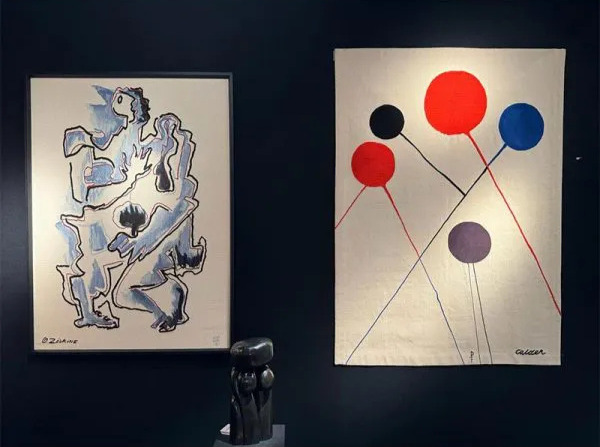
For these drawn to buying an Alexander Calder tapestry, a number of concerns matter as a lot because the composition itself. Workshop and weaving atelier are central to worth and authenticity — the Aubusson ateliers that labored immediately from Calder’s designs carry a documented historical past price understanding. Version dimension and numbering, documented provenance, exact dimensions, and the situation of the wool — together with colour preservation, structural integrity and any indicators of previous restoration — all contribute to assessing a piece. As with all vital textile artwork acquisition, working with a gallery skilled particularly in trendy tapestry is invaluable.
For collectors excited by exploring this discipline additional, galleries with a longstanding experience in textile artwork can present worthwhile steering on attribution, provenance, situation and historic context. Boccara presents an necessary number of Alexander Calder tapestries, alongside textile works by different main figures of twentieth-century artwork.
What makes Calder’s tapestries really feel so of-the-moment, in the end, isn’t nostalgia for mid-century modernism. It’s that his intuition for stability, colour and joyful abstraction was all the time, in some sense, forward of its time — and woven in wool, at scale, on a up to date wall, it nonetheless is.
Extra to Love!
Love Simply Occurs: The Story of KOKET
D’ORO and the Savoir-faire of Books

